Home Theater Equipment Guides
Most homeowners approach equipment selection the wrong way: they start with a speaker brand or a projector model and work backward to figure out whether the room can accommodate it. The room should come first.
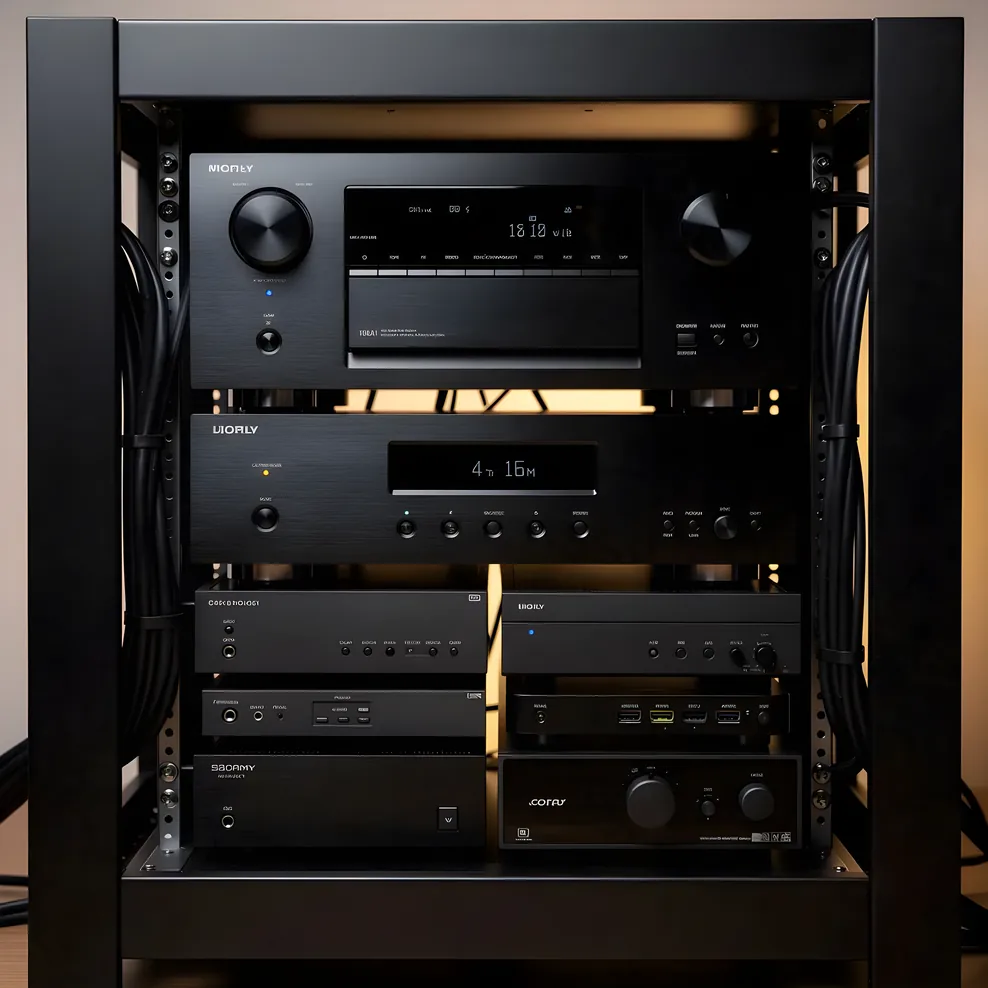
That sequence matters more than it sounds. A projector rated for 3,000 lumens may be exactly right for a light-controlled dedicated room and completely wrong for a bonus space with afternoon sun. A 7.2.4 Dolby Atmos configuration may be achievable in a 14-by-18-foot converted bedroom and impossible in the same square footage with an 8-foot ceiling. The equipment guides in this section are built around that logic: understand what your room requires, then specify what goes into it.
These guides are planning resources, not product reviews. You will not find ranked lists of the ten best receivers or comparison charts of receiver A against receiver B. What you will find is the framework for deciding what category of equipment your space actually needs and what specifications matter for your situation.
Projector vs TV for Home Theater
The first equipment decision in most dedicated theater rooms is also the most consequential one: projection or flat-panel display? Both can produce excellent pictures. They do not perform equally in all environments, and they carry meaningfully different installation requirements.
The projector-versus-TV question is not settled by picture quality alone. Throw distance, ambient light levels, ceiling height for mounting, and how the room will be used when it is not a theater all factor into the answer. A pull-down screen in a family room that doubles as a living space creates a different set of constraints than a fixed-frame screen in a room that only exists as a cinema.
Read the full projector vs TV guide for a room-by-room decision framework covering screen size, ambient light, cost over time, and which setup fits which use case.
How to Choose a Home Theater Projector
Once you have decided that projection is the right approach for your room, the next layer of decisions opens up: throw ratio, lumen output, resolution, and lens shift. These specifications interact with each other and with your specific room geometry in ways that product listings rarely explain well.
Throw ratio determines how far back the projector needs to sit to fill your screen size. In a Bay Area home where the available room depth is often 12 to 15 feet rather than the 20-plus feet that comes standard in a purpose-built basement theater, throw ratio can determine whether a projector is even usable in your space. A standard-throw unit that needs 18 feet to fill a 120-inch screen will not work in a converted bedroom. A short-throw or ultra-short-throw projector addresses that constraint, but introduces its own tradeoffs around image uniformity and placement flexibility.
Lumen output tells you how bright the projector is, but the number only means something relative to your room's light control. A 2,000-lumen projector in a properly darkened room can look spectacular. The same unit in a space with light leakage from a hallway or a west-facing window will look washed out.
Read the projector buying guide for a full breakdown of throw ratios, lumen requirements by room type, 4K versus 1080p considerations, and what actually matters for a Bay Area conversion room.
Home Theater Projector Screen Guide
A projector is only as good as the surface it throws onto. The screen is not an afterthought; it is half the display system, and the choice of screen type has as much impact on the final image as the projector itself.
Fixed-frame screens deliver the flattest, most consistent surface and are the standard choice for dedicated rooms where the screen is always in view. Pull-down screens retract when not in use, which makes them the practical option for shared spaces where the room needs to look like a living room when the projector is off. Ambient light-rejecting screens are a third category designed to maintain contrast in rooms that cannot be fully darkened.
For Bay Area homes with older construction, one additional variable comes into play: wall condition. A Victorian plaster wall or a stucco exterior wall is often not flat enough to paint-on or wall-mount a screen without surface preparation first. The installation method matters as much as the screen type.
Read the screen guide for a full comparison of fixed-frame, pull-down, and ALR screens, including how to match screen gain to your projector's lumen output and your room's light situation.
Dolby Atmos Home Theater
Dolby Atmos is the surround sound format that adds height channels to the conventional horizontal speaker plane. The result is three-dimensional audio with sounds that can move overhead, not just around the room. It has become the standard for dedicated home cinema rooms and is increasingly common in media room setups.
What the marketing materials do not always explain clearly is that Atmos is a room design question before it is an equipment question. Ceiling-mounted height speakers require a ceiling that can accept them. Atmos-enabled bookshelf speakers that fire upward toward the ceiling work only when the ceiling is the right height and material to reflect sound back down to the listening position. A room with an 8-foot ceiling or an irregular ceiling plane may not be a good candidate for traditional overhead speaker placement.
The number of channels you can run also depends on room geometry. A 5.1.2 configuration (five surround channels, one subwoofer, two height channels) fits most converted rooms. A 7.2.4 configuration requires more lateral width and ceiling clearance. Getting the channel count wrong for your room does not produce proportionally less good sound; it often produces worse sound than a correctly matched simpler system.
Read the Dolby Atmos planning guide for a room-first breakdown of height speaker options, channel configuration by room size, and what your ceiling needs to make overhead audio work.
Home Theater Acoustic Panels
Acoustic treatment is the component that most homeowners either skip entirely or buy blindly from product listings without understanding where panels go or why. The result in both cases is a room that sounds worse than it should, regardless of what the speakers cost.
Acoustic panels serve two distinct functions that are often confused: absorption and diffusion. Absorptive panels reduce reflections and tame high-frequency harshness. Bass traps handle low-frequency buildup at room corners, which is one of the most common causes of boomy, indistinct bass in small rooms. Diffusive panels scatter sound to maintain liveliness in rooms that have been over-treated. A room that needs all absorption and no diffusion will sound dead and unpleasant.
Panel placement follows predictable acoustic principles. First reflection points on the side walls, the ceiling above the listening position, and the rear wall are the primary treatment zones. Bass traps at floor-to-ceiling corners address the low end. Bay Area homes add a wrinkle: plaster walls and hardwood floors are common, and both are more reflective than the drywall and carpet that most acoustic treatment guides assume. Treatment requirements in a Victorian room with plaster and hardwood are different from the same room built with drywall and carpet.
Read the acoustic panel placement guide for treatment placement by room type, bass trap sizing, and how Bay Area construction materials change the acoustic equation.
Choosing a Home Theater Receiver
The AV receiver is the hub of a conventional home theater system. It takes audio signals from your source components, decodes surround sound formats, amplifies the signal, and distributes it to each speaker. Choosing the right one means matching it to your speaker count, your room size, and the audio formats you plan to use.
Channel count is the most visible specification: a 7.2 receiver handles seven speakers and two subwoofers, while a 9.2.4 receiver handles nine speakers, two subwoofers, and four height channels for full Dolby Atmos. The channel count you need is determined by your speaker configuration, which is in turn determined by your room. A 5.1.2 Atmos system needs a receiver with at least two height-channel amplifier outputs; a 7.2.4 system needs more. Buying a receiver that exceeds your current speaker count by a channel tier or two is a reasonable hedge if your room could accommodate expansion later.
Power output, expressed in watts per channel, is a specification that is frequently misread. Higher numbers are not always better. The power requirement depends on speaker sensitivity and room size. A pair of high-sensitivity floor-standing speakers in a small room may be driven to very high volume levels by a modest amplifier. The same amplifier may not have enough headroom for a larger room with lower-sensitivity speakers. The watt count on the spec sheet is only useful in context.
Read the receiver planning guide for a practical breakdown of channel configurations, power requirements by room size, and the features that matter versus the ones that are marketing noise.
How These Guides Fit Together
Equipment decisions are connected. The projector you choose affects which screen type makes sense. The screen size and room dimensions affect speaker placement options. The speaker configuration determines the receiver you need. The room's acoustic character, shaped by its construction materials and geometry, affects how all of it sounds.
The guides above cover each component category individually, but the underlying logic is always the same: the room drives the specification, not the other way around. If you are still in the room planning stage, the home theater design guides and planning resources cover dimensions, layout, and acoustic treatment as design decisions before equipment enters the picture.
For Bay Area homeowners with specific constraints, the Bay Area home theater guide addresses the local variables that most national equipment guides assume away: older housing stock, electrical panel capacity, California permitting, and the contractor labor rates that make installation cost a meaningful input into equipment budgeting.
When you are ready to talk to an installer, the guide to choosing a home theater installer covers what questions to ask, what licenses to verify, and how to evaluate the difference between an AV integrator and a general installer for a project of this scale. The full planning guide library is at Bay Area Home Cinema.