Dolby Atmos Home Theater: What Your Room Actually Needs
Dolby Atmos is often described as surround sound that goes overhead. That description is accurate but incomplete in a way that matters for planning. The more useful framing is this: Atmos adds a height layer to audio that was previously limited to a flat horizontal plane. A helicopter in a standard 5.1 mix moves left and right. In an Atmos mix, it can arc overhead from front to back and move at any elevation angle. When it works well, it changes how the room feels, not just how it sounds.
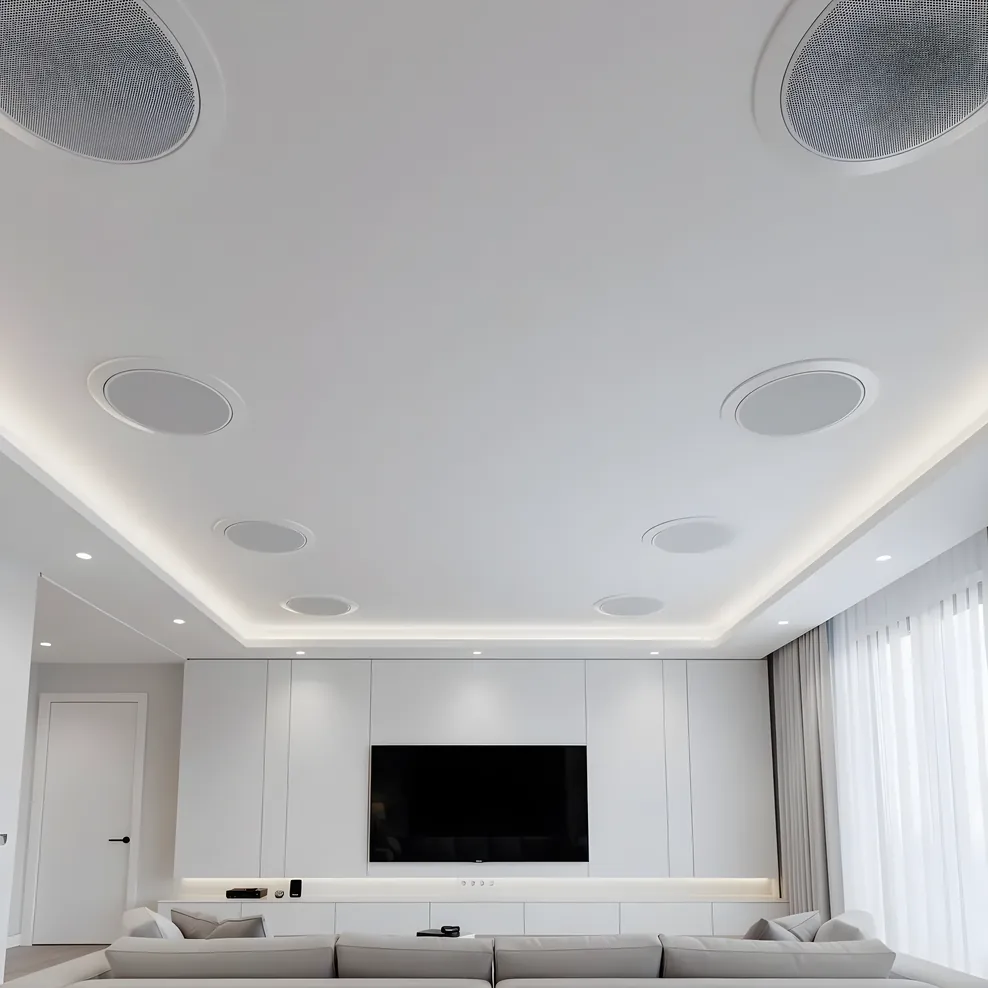
Whether it will work in your room depends almost entirely on the ceiling above the listening position. The equipment side is largely solved: receivers that decode Atmos are widely available, and content in Atmos format now spans streaming services, Blu-ray, and gaming. The room side is where planning gets specific.
How Dolby Atmos Actually Works
Conventional surround sound assigns audio to fixed channels arranged on a horizontal plane around the listener. A mixing engineer places a sound in the left surround channel, and it plays from the speaker physically located to the left rear. That assignment is static.
Atmos changes the model. Sounds in an Atmos mix are placed as objects with X, Y, and Z coordinates, along with metadata describing how they should move. The decoder in your receiver translates those coordinates into speaker assignments dynamically, based on the number and placement of speakers in the room. A system with two height speakers and a system with four will produce different results from the same object-based mix, with the four-speaker setup offering more precise localization.
This object-based approach is what makes Atmos format-forward: the same encoded content produces increasingly detailed spatial audio as you add more channels, rather than being locked to a fixed channel count the way older formats were.
Speaker Layouts: What the Numbers Mean
Atmos configurations are described with three numbers separated by periods. A 5.1.2 system has five surround speakers (left, center, right, left surround, right surround), one subwoofer, and two overhead channels. A 7.1.4 system expands that to seven surround speakers and four overhead channels.
The standard configurations for home use:
5.1.2 fits most converted rooms. Two overhead channels provide meaningful height, and the channel count is achievable in rooms with modest ceiling access. This is the right starting point for a first Atmos installation in a Bay Area conversion room.
7.1.2 adds two more surround channels in rooms with enough lateral width to place wide or rear-surround speakers appropriately. The ceiling channel count stays at two, so overhead installation demands are the same as 5.1.2.
5.1.4 and 7.1.4 add a second pair of overhead channels, with front and rear height pairs bracketing the listening position. The improvement in spatial precision is real, but it requires ceiling access at two locations per side rather than one. In a room where ceiling work is already difficult, doubling the overhead channel count doubles the installation challenge.
9.1.4 and above are for rooms purpose-built around the format or undergoing significant renovation. Realistic in a dedicated cinema room with accessible ceiling structure; impractical in most conversion projects.
For most Bay Area homeowners planning a first dedicated cinema room or media room upgrade, 5.1.2 is the floor and 7.1.4 is the ceiling of what makes sense. The incremental benefit of 9.1.4 does not justify the ceiling work required in an existing home.
In-Ceiling Speakers vs Upfiring Height Channels
This is the decision point where room construction matters most.
In-ceiling speakers are physically mounted into the ceiling above the listening position. They fire straight down and deliver sound from the actual location of the height channel. The localization is accurate, the performance is consistent, and the installation is permanent. The tradeoff is that getting speakers into the ceiling requires ceiling access, which means either routing wire from above (through an attic or joist bay) or cutting into the ceiling surface itself.
Upfiring speakers are add-on modules that sit on top of a floor-standing speaker or bookshelf enclosure, angled toward the ceiling. They fire upward, rely on the ceiling to reflect that sound back down to the listening position, and produce a height impression rather than a precisely localized overhead channel. They require no ceiling work, and the installation is as simple as placing a speaker on top of another speaker and running wire to an additional amplifier output on the receiver.
The gap in performance between the two approaches is real. In-ceiling speakers deliver better localization and more consistent results across different listening positions. Upfiring speakers are a ceiling-reflection trick that works under specific conditions and fails under others. The conditions where upfiring performs acceptably: ceiling height between 8 and 9.5 feet, a flat and relatively smooth ceiling surface, and a listening position directly below the speaker's aim point.
In Bay Area homes, those conditions are frequently not met.
The Bay Area Ceiling Problem
Older Bay Area housing stock introduces two ceiling complications that most national guides skip over.
Plaster-and-lath construction is common in Victorian, Craftsman, and early Bungalow homes throughout the East Bay, San Francisco, and the Peninsula. A plaster ceiling is significantly harder to cut into than drywall. The lath backing means you cannot simply locate a joist, cut a hole, and drop a speaker in. The plaster surface can crack during cutting if not handled carefully, and patching plaster to match original texture is skilled work. If you are planning in-ceiling speakers in a home with original plaster ceilings, budget for the additional installation time and material, and confirm with the installer that they have done plaster ceiling work before.
Wire routing in plaster ceiling construction often cannot follow the same paths used in drywall homes. Fishing wire through a plaster ceiling from above requires attic access. Not all Bay Area homes have accessible attics above every room, and some converted spaces have structure between floors that blocks vertical wire runs. When wire cannot be routed through the ceiling, surface conduit becomes the fallback, which affects the aesthetics of the finished room.
For many Bay Area homeowners with plaster ceilings, the honest answer is that in-ceiling Atmos speakers are achievable but more expensive and more disruptive than the same work in newer construction. That cost difference shifts the calculation toward upfiring speakers in some cases, or toward a different room for the dedicated cinema in others.
Upfiring speakers in a plaster-ceiling room face a separate issue: plaster surfaces are irregular in texture and often not perfectly flat. The reflective properties of a plaster ceiling differ from smooth drywall, and upfiring performance depends on a predictable and consistent reflection angle back to the listening position. In some rooms this works fine. In rooms with textured plaster, coffered ceilings, or ceiling heights above 10 feet, the reflection-based approach produces muddier and less convincing height imaging.
Receiver Requirements for Dolby Atmos
An Atmos configuration requires a receiver that can decode the Dolby Atmos format and provide amplifier outputs for the height channels. Virtually any current-generation AV receiver includes Atmos decoding. The practical question is channel count.
A 5.1.2 system needs a receiver with at least seven total amplifier channels: five for the main surround array and two for the overhead pair. A 7.1.2 system needs nine channels. A 7.1.4 system needs eleven channels. Many mid-range receivers advertised as "9.2 channel" or "11.2 channel" include some channels that are shared between surround and Atmos configurations, so confirm the spec carefully: you want the receiver to run all channels simultaneously, not to switch between them.
Power output matters here in a way that is easy to overlook. Overhead speakers are typically smaller drivers mounted at ceiling level and facing the listening position from directly above. They do not need the same power as floor-standing surround speakers. Matching the amplifier output to the sensitivity of the speakers being driven is more important than raw watt count, and a well-matched lower-power receiver will outperform an overpowered one driving mismatched speakers.
The other relevant receiver specification is HDMI connectivity. Current Atmos content arrives over HDMI from a source device (streaming box, 4K Blu-ray player) and requires HDMI 2.0 or later with eARC support for audio return from the display. If your room design involves a projector with HDMI connected to the screen side and a separate audio path, confirm how the Atmos signal routes to the receiver before specifying the component chain.
Content Availability
Atmos content is no longer a niche format. The major streaming services deliver Atmos audio on premium subscription tiers. 4K Blu-ray discs frequently include Atmos tracks as the primary audio format. Gaming titles support spatial audio in ways that map meaningfully to Atmos height speaker configurations.
The supply of Atmos content is not the planning constraint. The room is.
If you are streaming content as the primary source, confirm that your streaming device outputs Atmos audio over HDMI. Several popular devices pass Atmos to the receiver correctly but require the format to be explicitly selected in audio output settings. A device set to output stereo or standard Dolby Digital will not trigger Atmos decoding even if the content is encoded in it.
Connecting the Equipment and Room Decisions
Dolby Atmos is not an equipment upgrade you add to a finished room. It is a format that requires the room to support it. Speaker placement and ceiling access are determined before installation day, ideally before the room is framed and wired. Retrofitting overhead speaker positions into a finished room is possible but more expensive than planning for them from the start.
If your room is still in the planning stage, the home theater room dimensions guide covers ceiling height requirements alongside the other spatial parameters that govern speaker placement. The ceiling height recommendations there connect directly to what this guide describes: 9 feet is the practical floor for in-ceiling overhead channels, and taller ceilings improve the options for both in-ceiling placement and upfiring reflection.
Acoustic treatment interacts with Atmos performance in a specific way worth noting. Overhead speakers introduce sound from a new axis, and early reflections from side walls and the ceiling plane are now part of the design challenge rather than just a correction task. The acoustic panels guide covers first-reflection treatment in detail, including the ceiling plane above the listening position.
The home theater receiver guide covers channel configuration and power matching in more depth, including what to look for in a receiver specification that will support your current layout while leaving room for future channel additions if the room ever gets the ceiling work done.
Return to the Equipment Guides hub for the full set of component planning guides, or move into the Bay Area home theater section if you are still working through the specific constraints that older Bay Area construction presents. The complete planning guide library for Bay Area home cinema is at Bay Area Home Cinema.
Frequently Asked Questions
What do I need for a Dolby Atmos home theater?
You need an Atmos-capable AV receiver, speakers with at least two height channels (either in-ceiling or upfiring), and source content encoded in Dolby Atmos. The room also needs a ceiling height of at least 8 feet for upfiring speakers, and ideally 9 feet or more for in-ceiling placement.
What is the difference between 5.1.2 and 7.1.4 Dolby Atmos?
The numbers refer to the channel count: main channels, subwoofers, and height channels. A 5.1.2 system has five surround speakers, one subwoofer, and two overhead channels. A 7.1.4 system adds two more surround channels and two more overhead channels. Larger rooms benefit from 7.1.4 or 9.1.4, but most converted rooms in Bay Area homes are well-served by 5.1.2.
Are upfiring Atmos speakers as good as in-ceiling speakers?
In-ceiling speakers generally deliver more accurate overhead localization because the sound comes directly from above. Upfiring modules reflect sound off the ceiling and depend heavily on ceiling height, material, and surface flatness. In rooms with flat, smooth ceilings at 8 to 9 feet, upfiring speakers can perform reasonably well. Rooms with plaster, coffered ceilings, or ceiling heights above 10 feet are poor candidates for the reflection-based approach.
Can I add Dolby Atmos to an existing surround sound system?
Yes, if your current receiver supports Dolby Atmos decoding. Many receivers from the past several years include Atmos support. You would add height-channel speakers (in-ceiling or upfiring add-on modules) to the existing system. If your receiver does not decode Atmos, you will need to replace or supplement it with one that does.
How do I run speaker wire for in-ceiling Atmos speakers in a Bay Area home with plaster ceilings?
Plaster-and-lath ceilings make wire routing significantly more difficult than drywall. You generally cannot fish wire through a plaster ceiling without opening it up. Options include running wire through the attic space if accessible, using surface-mounted raceway conduit, or opting for wireless height-channel speakers instead. A ceiling that requires major structural work to wire may shift the calculation toward upfiring speakers or a different layout.
Where should Dolby Atmos height speakers be positioned?
Dolby's guidelines place overhead speakers at roughly 30 to 55 degrees above the listening position. For a two-channel height setup, the speakers sit above and slightly in front of the primary listening seats. For four-channel height, a front pair sits above and ahead of the seats, and a rear pair sits overhead and behind. The goal is to bracket the listener with height channels, not aim them directly at the top of the listener's head.