Home Theater Acoustics: A Room Treatment Planning Guide
Room acoustics might be the most misunderstood part of home theater planning. Most people spend months picking speakers and projectors, then drop them into a bare room with drywall, hardwood, and a glass door, and wonder why everything sounds worse than the demo floor at the AV store. The room is the problem.
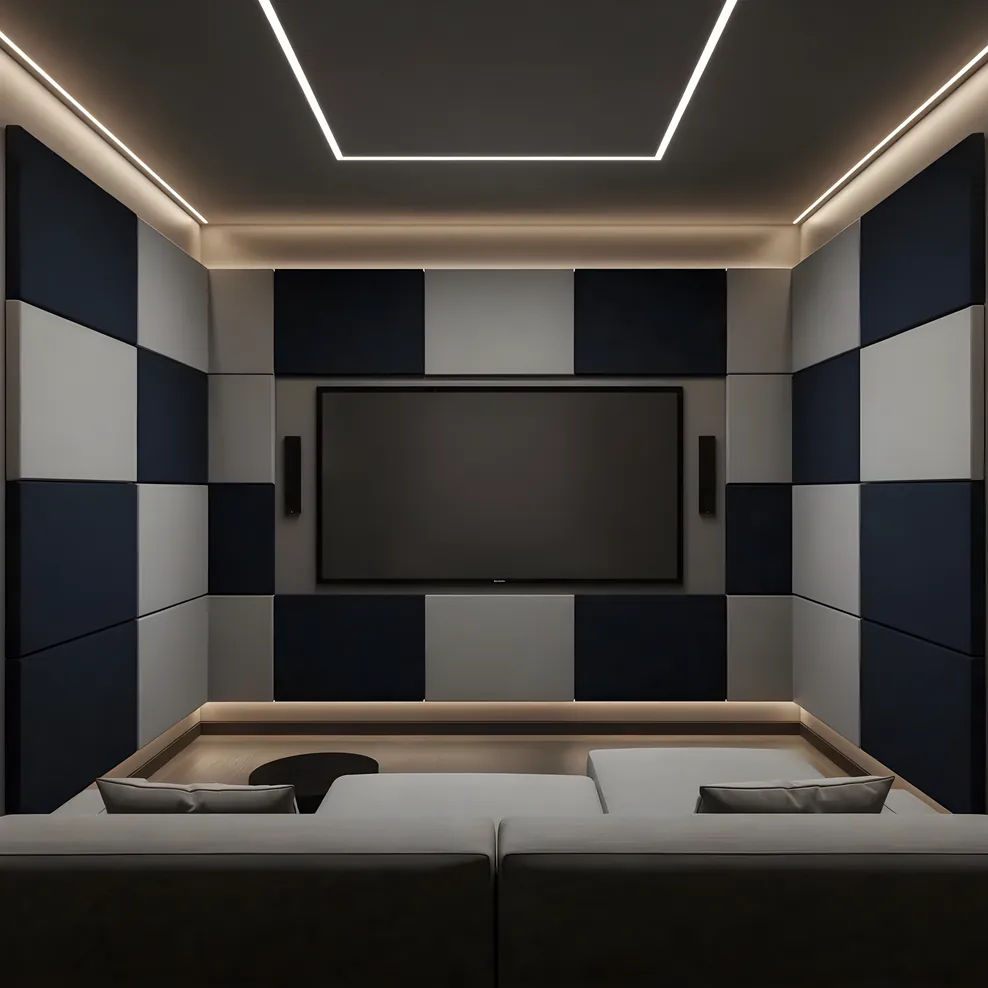
This guide covers the physics behind acoustic treatment, explains the difference between treating a room and soundproofing it (they are not the same thing), and walks through the specific challenges that come with Bay Area housing stock, from Victorian plaster walls to condo HOA floor restrictions.
Absorption, Reflection, and Diffusion: What Each One Does
Every acoustic treatment material does one of three things: it absorbs sound energy, reflects it, or scatters it. Understanding the difference tells you which product goes where.
Absorption converts sound energy into a small amount of heat. Soft, porous materials absorb well: fiberglass panels, mineral wool, thick foam, carpet, upholstered furniture. Thin foam wedges from the studio supply aisle absorb high frequencies adequately but do almost nothing below 500Hz. For a home cinema, you need at least 2-inch thick rigid fiberglass or mineral wool to treat the mid-range, and 4-inch or thicker panels to reach into the low-mid range where dialogue lives.
Reflection is what happens when sound hits a hard surface and bounces back. Drywall, glass, tile, and hardwood floors all reflect strongly. A reflection arriving at the listening position a few milliseconds after the direct sound creates comb filtering, which smears the stereo image and reduces intelligibility. The goal is not to eliminate all reflections, which would produce an unnaturally dead room, but to control them at the points where they cause the most damage.
Diffusion scatters sound in multiple directions instead of reflecting it as a coherent wavefront. Diffuser panels, typically wooden slats or QRD (quadratic residue diffuser) arrays, break up reflections without absorbing the energy. The result is a sense of spaciousness without the liveliness penalty. In a dedicated cinema room, diffusion typically goes on the rear wall and upper side walls, while absorption handles the first reflection points.
A well-treated home theater uses all three in combination: absorption at first reflection points and the front wall, diffusion at the rear wall and back third of the room, and bass traps in the corners.
RT60: The Number That Tells You How Your Room Actually Sounds
RT60 is the time, measured in seconds, it takes for sound to decay by 60 decibels after a source stops. It is the single most useful number for evaluating a room's acoustic behavior.
A bare room with drywall walls, hardwood floors, and a flat ceiling typically measures an RT60 of 0.8 to 1.2 seconds. At that level, you hear an audible tail of reverb after every transient, dialogue sounds like it was recorded in a hallway, and bass notes blur together. The target RT60 for a home theater is 0.3 to 0.5 seconds, which is short enough to maintain clarity without sounding anechoic.
You can measure RT60 with a free app (REW, or Room EQ Wizard, is the standard tool) and a calibrated measurement microphone. Play a short burst of pink noise, stop it, and the app graphs the decay. Most rooms reveal immediately that they need treatment. After placing absorption panels at the primary reflection points, a second measurement shows the improvement.
The caveat: RT60 varies by frequency. A room might be well-controlled at 1kHz but still ring badly at 200Hz. This is where bass traps become essential, and it is also why "carpet and a couch" is not a complete solution.
First Reflection Points: Where to Put Your Panels
The first reflection point is the spot on a wall or ceiling where sound from your speakers bounces directly to your listening position. These are the highest-priority locations for absorption panels because first reflections arrive close enough in time to the direct sound that the ear partially integrates them, smearing imaging and reducing clarity.
To find the side-wall first reflection points, sit in your primary listening position and have someone hold a mirror against the side wall and slide it forward until you can see a speaker in the mirror. That is the first reflection point. Repeat for both sides. The ceiling has a first reflection point directly above and slightly in front of the listening position, and so does the wall directly behind the speakers (the front wall).
Placing 2-inch to 4-inch absorption panels at these five to seven locations produces a significant and immediate improvement in clarity, even before you address the rest of the room. If you can only afford one round of treatment, start here.
Bass Management and Room Modes
Bass is the hardest acoustic problem in any home theater, and it cannot be solved by surface treatment alone. Low frequencies, typically below 300Hz, behave as pressure waves rather than traveling in straight lines. They fill the room and create standing waves at frequencies where the room dimensions are multiples of the wavelength.
In a room that is 15 feet long, the fundamental axial mode along the length dimension occurs at roughly 38Hz. The second mode is at 76Hz, the third at 114Hz, and so on. At these frequencies, the bass level varies dramatically depending on where you sit. One position might have a 6dB peak at 76Hz; move three feet and you have a 6dB null. This is why your subwoofer might sound boomy in the listening chair but thin on the couch.
The practical solutions are layered. First, place bass traps in the room's corners, where pressure buildup is highest. Floor-to-ceiling corner treatment using 4-inch or thicker rockwool panels addresses the worst of the modal buildup. Second, experiment with subwoofer placement: positioning it at roughly one-third or one-fifth of the room length along the long wall tends to excite fewer modes simultaneously. Third, use your AV receiver's built-in room correction system (most modern receivers include one) to apply digital EQ at the listening position, flattening the measured response.
Digital correction handles seat-to-seat variation poorly, but it is effective at taming severe peaks at a fixed listening position. Combined with physical bass trapping, it gets most rooms to a satisfying result.
Soundproofing vs. Acoustic Treatment: Two Completely Different Problems
This distinction matters more in Bay Area housing than almost anywhere else. Soundproofing keeps sound from crossing from one space to another. Acoustic treatment controls how sound behaves within a space. The materials and methods are entirely different, and one cannot substitute for the other.
Acoustic panels mounted on the interior walls of your theater will not stop your neighbor in the adjacent condo from hearing your subwoofer. Mass-loaded vinyl (MLV) stapled to a wall will not reduce the echo inside your room. Confusing these two categories leads to expensive mistakes.
Soundproofing: STC Ratings and What They Mean
The STC (Sound Transmission Class) rating of a wall assembly describes how much airborne sound it blocks. Higher numbers mean more isolation.
A standard single-stud wall with one layer of drywall on each side, no insulation, achieves roughly STC 33. This stops little. The same wall with insulation in the cavity reaches STC 38 to 40. Adding a second layer of drywall with Green Glue damping compound between layers gets you to STC 50 to 55, which is adequate for moderate listening levels but will not contain serious subwoofer output.
A room-within-a-room construction, where the inner walls are built on a separate stud structure that does not touch the outer framing, with floating floors and a decoupled ceiling, can achieve STC 60 to 65. This is the approach for genuine home theaters in shared-building environments. It is also expensive, reduces usable room dimensions by six to eight inches on every surface, and requires a contractor with experience in acoustic construction.
Mass-Loaded Vinyl
MLV is a dense, limp vinyl sheeting (typically 1 lb per square foot) that adds mass to walls, floors, and ceilings to increase STC ratings. It is commonly used as part of a composite assembly rather than as a standalone solution. Sandwiched between layers of drywall with damping compound, or used as a floor underlayment beneath a floating subfloor, it contributes meaningfully to isolation. It does nothing for acoustic treatment inside the room.
Bay Area Specifics: Condos, Townhomes, and Noise Ordinances
Shared walls in Bay Area condos and townhomes are the most common acoustic challenge for home cinema planning here. Standard residential construction in most Bay Area condo buildings dates from the 1960s through the 1990s and achieves STC 40 to 48 in party walls, meaning your neighbors will hear anything above moderate listening levels, particularly bass.
California cities vary on noise ordinances. San Francisco's residential noise ordinance prohibits sounds that disturb neighbors during daytime hours and has a lower threshold at night (generally after 10pm). Oakland, San Jose, and other cities have similar frameworks. In practice, subwoofer frequencies are the most common complaint because low-frequency sound travels through structure, not just air, bypassing even well-constructed walls. If your theater is below a neighbor (in a stacked unit), floor isolation via floating subfloor and decoupled ceiling becomes the priority.
HOA restrictions are an additional factor. Many Bay Area condo HOAs require hard-surface flooring in living spaces. If carpet is not permitted, your acoustic treatment budget for the floor needs to redirect to more wall and ceiling panels, and you should expect the room to need more treatment overall. A concrete slab with a hardwood finish and no rug is acoustically one of the worst starting points for a home cinema.
Acoustic Panels: Planning Placement Before Buying
For further detail on panel selection, materials, and placement diagrams, the acoustic panels guide in the Equipment section covers specific product categories and configuration options.
The planning question here is: how much coverage do you need? A rough rule for a dedicated home theater is that 25 to 35 percent of total wall and ceiling surface area should be treated, with treatment concentrated at the reflection points rather than spread uniformly. Spreading thin panels uniformly often costs the same as targeted placement at key locations but produces noticeably worse results.
Priority order for panel placement:
- Front wall (behind the screen or projection surface) using thick absorption
- Side-wall first reflection points at ear height
- Ceiling first reflection point
- Corner bass traps, floor to ceiling if possible
- Rear wall with a mix of diffusion and absorption
What to Do Before You Build
The home theater planning hub covers the full pre-design checklist, including room selection and dimensions. From an acoustic standpoint, the most important early decision is room selection. A rectangular room with no parallel surfaces at exactly equal dimensions is better than a perfect cube or square. Rooms that are 1.6 times as long as they are wide, and 0.6 times as tall as they are wide, fall on what acoustic consultants call the "Bolt area" of favorable room ratios. You rarely get to choose freely in a converted Bay Area bedroom, but if you have options, proportions matter more than square footage.
For context on how room dimensions interact with seating layout and screen placement, the home theater room dimensions guide covers the spatial requirements in detail, including minimum room size recommendations by screen size and seating row count.
If you are comparing a dedicated room against a media room conversion, the media room vs. home theater guide covers how acoustic requirements differ between the two configurations.
Frequently Asked Questions
What is RT60 and why does it matter for a home theater?
RT60 is the time it takes for sound to decay by 60 decibels after a source stops. In a typical home theater, the target RT60 is 0.3 to 0.5 seconds. Rooms with longer decay times, above 0.6 seconds, produce audible reverb that muddies dialogue and smears surround effects. Hard-surfaced rooms with no treatment often measure 0.8 to 1.2 seconds.
What is the difference between soundproofing and acoustic treatment?
Soundproofing reduces how much sound crosses a wall or floor. Acoustic treatment changes how sound behaves inside the room. They solve different problems and use completely different materials. Acoustic panels inside a room do nothing to stop sound from reaching a neighbor. Mass-loaded vinyl on a wall does nothing to eliminate echo inside the room.
Do I need acoustic panels in my home theater?
Almost certainly yes, unless your room already has wall-to-wall carpet, upholstered furniture on every wall, and a soft ceiling treatment. Hard floors, drywall, and glass all reflect high-frequency sound back into the listening position, which creates comb filtering and muddies the stereo image. Even a modest treatment package at the first reflection points and front wall makes a measurable difference.
What STC rating do I need for a home theater wall?
A standard residential drywall partition achieves roughly STC 33. A home theater wall targeting STC 50 to 55 requires doubled drywall on resilient channels or a fully decoupled stud wall with dense-pack insulation. STC 60 and above requires a room-within-a-room approach with floating floors, decoupled ceiling, and mass-loaded vinyl as part of the assembly.
How do I deal with bass problems in my home theater?
Bass problems in a home theater stem from room modes: standing waves at frequencies where the room dimensions are a fraction of the wavelength. The most practical fixes are corner bass traps, subwoofer placement at one-third or one-fifth of the room length, and using your AV receiver's room correction system to apply digital EQ at the listening position.
What are the Bay Area-specific acoustic challenges for home theaters?
Condos and townhomes in the Bay Area present two distinct problems: shared walls with neighbors (a soundproofing concern) and hard floors required by HOA rules (an acoustic treatment concern). Victorian and Craftsman homes with wood floors, plaster walls, and tall ceilings have long RT60 values that need significant absorption. California noise ordinances also vary by city and time of day, so understanding local rules before designing a dedicated theater room is worth doing early.
Starting With the Room, Not the Gear
Acoustics is where most home theater planning gets reversed. Speakers, receivers, and projectors get selected first; the room comes last, usually after everything is already installed. The result is that the room's acoustic problems become permanent features rather than planned-for variables.
The better sequence: choose the room, measure or estimate its RT60 and modal characteristics, then size the treatment budget alongside the equipment budget. A modest speaker system in a well-treated room consistently outperforms expensive equipment in an untreated space. This is the clearest argument for getting acoustics right at the planning stage rather than retrofitting after the fact.
For Bay Area homeowners ready to move from planning to installation, bayareaavpros.com connects you with AV integrators who specialize in dedicated cinema rooms, including the acoustic construction considerations specific to Bay Area building stock. The complete guide collection is at Bay Area Home Cinema.