Home Theater Flooring
Flooring is not the first thing most people think about when planning a home cinema. The screen, the projector, the seating arrangement — those feel like the real decisions. Flooring reads as background, something you choose for how it looks and then forget about.
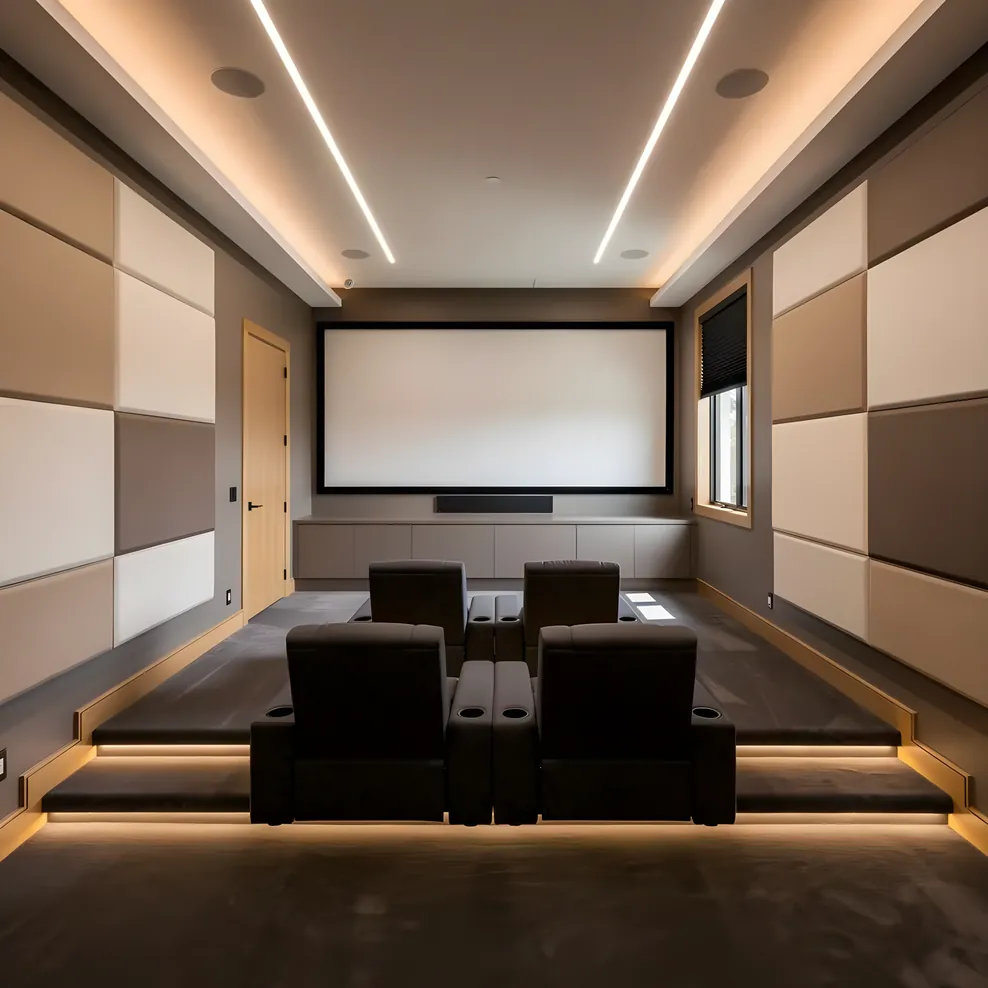
That instinct is mostly wrong. The surface under your feet is part of the acoustic environment, and in a room designed for audio performance, every parallel surface pair matters. Flooring also matters for containment: how much low-frequency energy transfers into the room below, how footstep noise reads during quiet passages, how a room feels to move through in the dark. These are not secondary considerations once you start using the room seriously.
The question of which floor is right also looks different in the Bay Area than it does in a national guide. Most Bay Area homes from the Victorian and Craftsman eras have original hardwood floors — fir, oak, or pine that has survived a hundred years and adds genuine character to the space. Pulling those floors up to install carpet is rarely the right answer. Understanding how to build a well-performing theater room around existing hardwood is a more useful question than asking which floor is theoretically best.
How Flooring Affects Acoustics
To make a good flooring decision, it helps to understand what flooring actually does (and does not do) acoustically.
High-frequency reflections
Sound in a room reflects off every surface it hits. Hard surfaces — concrete, hardwood, tile, bare drywall — reflect high-frequency energy almost completely. Soft surfaces — carpet, thick rugs, acoustic panels, upholstered furniture — absorb it. In a room with hard floors and minimal acoustic treatment, you will hear flutter echo: a rapid, repeating reflection that bounces between the floor and ceiling and between parallel walls. The effect shows up as a slight ringing quality on voices and cymbals, a harshness that sits just underneath what you are watching.
Carpet addresses this directly. A carpet-covered floor absorbs a meaningful portion of the high-frequency energy that would otherwise reflect upward, and that absorption breaks one leg of the floor-to-ceiling flutter path. The audible result is a cleaner, less fatiguing listening environment.
Bass and low-frequency behavior
Flooring has much less direct influence on bass. Low-frequency energy travels as pressure waves through the room's air volume, and those waves do not interact with surfaces the way higher frequencies do. The room's dimensions, the placement of speakers and subwoofers, and the presence of bass traps in corners are what determine bass performance. Flooring material is not a meaningful variable here.
Where flooring does matter for low frequencies is in containment and transmission. A concrete slab conducts low-frequency energy differently than a suspended wood subfloor. In a garage conversion or ground-floor room with a slab, bass transmission to the space below is less of a concern than in a room with a wood-framed floor over a living space. This is a construction consideration more than a surface material question, but it is worth understanding if you are building from scratch or evaluating a basement or garage conversion.
Footstep noise
Hard floors transmit footstep impact noise into the structure of the building, and that noise travels. In a room where people move around occasionally during a film, a hard floor makes those movements more audible to everyone seated and, in a multi-story home, to anyone in the rooms below. Carpet absorbs impact noise at the source. This is especially relevant in older Bay Area homes where suspended wood floors have more acoustic coupling to the structure than modern construction.
The Flooring Options
Carpet
Carpet is the acoustically correct choice for a dedicated theater room, and for a room that is starting from bare subfloor, there is no reason not to use it. A cut-pile or loop-pile carpet in a mid-range pile density (not the lowest grade, not so plush that walking on it in the dark becomes a safety issue) will absorb high-frequency reflections, control footstep noise, and give the room the feel of a genuine cinema environment.
Practically, carpet is also forgiving to install, easy to find at a wide range of price points, and simple to replace in the future if the room changes use. For a dedicated room that will never be anything other than a theater, there is no performance or aesthetic argument against it.
The aesthetic argument for carpet in a Bay Area context is weaker. Many Bay Area homeowners are converting spaces in homes where the original flooring has value — historical, financial, or both. Installing carpet in a room that already has original fir floors feels like a permanent loss even if it is technically reversible.
Hardwood with area rugs
In a room that already has hardwood floors, the most practical and acoustically effective approach is a large area rug covering the entire seating zone. The key word is large: a rug that sits under the coffee table and in front of the couch does not address the acoustic problem. The rug needs to cover the floor from the front of the screen to behind the last row of seating, and ideally extend to the side walls.
Beneath the rug, a dense rug pad — not the thin foam kind from a home goods store, but a felt-and-rubber pad at 1/4 inch or thicker — adds both acoustic mass and underfoot comfort. A quality rug-and-pad combination absorbs meaningfully more high-frequency energy than a thin rug directly on the floor.
This approach is the right answer for most Bay Area rooms in pre-1970 housing. The original floors stay intact, the acoustic performance improves substantially, and the room looks intentional rather than compromised. It is also easier to adjust over time: if a second row of seating gets added, the rug can be replaced with a larger one.
The limitation is that a rug, even a good one, does not absorb as broadly as carpet across the full floor area. The hardwood at the edges and in the aisles between seats still reflects. If you are building a high-specification dedicated room and are not constrained by existing floors, carpet covers more surface and performs better.
Luxury vinyl plank (LVP)
Luxury vinyl plank is an increasingly common choice for garage and basement conversions, where you are finishing a concrete slab and want something more resilient and comfortable than bare concrete. Acoustically, LVP on its own behaves like hardwood: it reflects high frequencies and transmits footstep impact. Paired with a thick acoustic underlayment (at minimum 2mm, ideally 3-4mm) and a large area rug over the seating zone, it performs reasonably well.
LVP is also moisture-resistant, which matters in a garage or below-grade conversion where the slab may have some moisture vapor transmission. Carpet in a garage conversion can develop mildew issues over time if the moisture situation is not handled first; LVP is more tolerant of marginal conditions.
The tradeoff is the same as hardwood: without a rug covering the primary listening area, a vinyl floor is acoustically worse than carpet. LVP makes sense in conversions where resilience, moisture resistance, and a finished residential look matter more than maximizing acoustic absorption from the floor surface alone.
Concrete
Bare concrete shows up in garage and basement conversions where the homeowner either cannot afford to finish the floor yet or prefers the industrial aesthetic. Acoustically, concrete is the hardest floor surface in common use, reflecting nearly all sound energy with very little absorption.
A garage conversion with bare concrete, bare drywall walls, and no acoustic treatment will sound like a parking structure. Concrete is a workable starting point for a conversion project, but it needs to be understood as a surface to be covered, not a finished floor. A thick rug or LVP over a good underlayment will substantially change the acoustic character.
The Bay Area Hardwood Question
Most national home theater guides present flooring as a binary: install carpet and get good acoustics, or keep hardwood and accept worse sound. This framing misses the actual decision Bay Area homeowners face.
Original hardwood in a Victorian in Alameda, a Craftsman in Berkeley, or a Mid-Century in Marin is worth preserving. Refinishing that wood properly costs money and reflects genuine care for the building. Covering it with carpet is a choice that affects the resale value and character of the home, not just the room.
The more useful question is how much acoustic performance you can recover through non-floor treatment. The answer, for most rooms, is: enough to build a very good theater. Wall treatment, ceiling treatment, proper speaker placement, and a quality rug over the primary seating zone address the main acoustic issues that arise from a hard floor. A room with hardwood floors, well-placed acoustic panels on the walls and ceiling, and a large area rug will sound substantially better than a room with carpet and no other treatment.
For the design guide for Bay Area-specific home theater design, this principle is part of the broader point: working with what the house already offers produces better results than fighting the building. Hardwood floors are not a problem to solve. They are a constraint to design around, and designing around them competently is something a good room can handle.
Acoustic Treatment Is the Rest of the Equation
No flooring choice, including carpet, eliminates the need for acoustic treatment on the walls and ceiling. The floor is one of six surfaces in the room, and treatment decisions on the other five matter at least as much.
Flutter echo between side walls is handled by panels and diffusers, not flooring. Early reflections off the front and side walls near the speakers are handled by absorption at the first reflection points. Bass buildup in corners is handled by bass traps, not by floor material. A room with wall-to-wall carpet and no other treatment will still have pronounced acoustic problems.
The home theater acoustics guide covers wall and ceiling treatment in depth, including panel placement for different room configurations. The flooring choice you make here should be understood as one input into a larger acoustic picture, not a substitute for the rest of it.
How to Choose
If you are starting with bare subfloor in a dedicated room, install carpet. The acoustic and practical case for it is straightforward, and you have no reason to accept the tradeoffs of a harder surface.
If you have original hardwood in a Bay Area home, keep it. Use a large, thick area rug with a quality pad under the seating zone, invest in wall and ceiling treatment, and you will end up with a room that performs well and respects what the house already has.
If you are converting a garage or basement slab, use LVP over a good acoustic underlayment, add a rug, and do not skip the wall treatment. Concrete under a finished surface is fine; bare concrete is not.
The flooring question is answerable once you know what you are starting with. For the rest of the design decisions that shape how the room performs, the home theater design guide connects flooring to the full picture of room planning, lighting, seating, and acoustic treatment. The full library of Bay Area home cinema planning guides is at Bay Area Home Cinema.
Frequently Asked Questions
Is carpet better than hardwood for a home theater?
Carpet absorbs high-frequency sound reflections that cause flutter echo and harshness, making it the strongest acoustic choice for a dedicated theater room. That said, hardwood with a large area rug covering the main seating zone performs reasonably well and preserves the character of older homes. The right answer depends on your room and whether you are starting from scratch or working with existing floors.
Does flooring affect bass in a home theater?
Flooring has relatively little direct impact on bass compared to walls and room dimensions. Low-frequency energy travels as pressure waves through the room volume, not primarily along surfaces. Where flooring matters for bass is in containing it: a concrete slab under carpet will transmit less low-frequency energy to adjacent spaces than a suspended wood floor. For bass control within the room, corner bass traps and subwoofer placement matter far more than the floor surface itself.
Can I use luxury vinyl plank in a home theater?
Yes, with the right underlayment. Luxury vinyl plank on its own is acoustically similar to hardwood: it reflects high-frequency sound and transmits footstep noise. Pairing it with a thick acoustic underlayment and a large area rug over the seating area recovers most of the acoustic benefit. LVP is a practical option for garage or basement conversions where you are going over concrete and want a finished surface without gluing carpet.
How do I work with existing hardwood in a Bay Area home theater?
The most effective approach is a large, thick area rug covering the entire seating zone, layered with a dense rug pad underneath. This absorbs the high-frequency reflections off the hardwood that cause flutter echo and dialogue harshness. Combine it with acoustic treatment on the walls and ceiling and you can build a well-performing room without touching the original floors. Bay Area Victorian and Craftsman homes often have original hardwood that is costly to replace and worth preserving; a quality rug-and-pad combination is the right solution for most of these rooms.
What is flutter echo and why does flooring affect it?
Flutter echo is a rapid, repeating reflection that occurs when sound bounces back and forth between two parallel hard surfaces. In a rectangular room, hard floors and ceilings create a vertical flutter path, and hard side walls create a lateral one. The effect is audible as a slight ringing or harshness on voices and high-frequency sounds. Carpet or a thick rug on the floor breaks one of those reflection paths, which reduces flutter echo across the listening position.